


A sample of Altar: Modern Psalms for a New Earth—A Contemporary Devotional for Seekers Beyond Dogma
Altar: Modern Psalms for a New Earth
A Contemporary Devotional for Seekers Beyond Dogma
Tori Gordon
Thought Catalog Books · thoughtcatalog.com
Copyright © 2026 Tori Gordon.
All rights reserved. No part of this book may be reproduced or transmitted in any form or any means, electronic or mechanical, without prior written consent and permission from Thought Catalog.
Published by Thought Catalog Books®, an imprint of Thought Catalog, a digital magazine owned and operated by The Thought & Expression Co. Inc., an independent media organization founded in 2010 and based in the United States of America. For stocking inquiries, contact stockists@shopcatalog.com.
Produced by Chris Lavergne and Noelle Beams
Art direction and design by KJ Parish
Circulation management by Isidoros Karamitopoulos
thoughtcatalog.com | shopcatalog.com
First Limited Edition Print
Printed in the United States of America
ISBN 978-1-965820-25-4
Table of Contents
The Arc of Altar: A Journey of Returning — 7
Dedication — 9
Preface: How This Book Found Me — 13
Introduction: You Are the Living Altar — 19
Living in Right Relationship: A New Earth Paradigm — 41
PART I: THE ALTAR OF ABUNDANCE — 51
For remembering the fullness that already surrounds you.
Psalm 1: For the One Who Feels Like Not Enough — 59
Psalm 2: For Calling In Overflow — 63
Psalm 3: For the Body As the Temple — 67
Psalm 4: For Worth Beyond Earning — 71
Psalm 5: For the One Learning to Receive — 75
Psalm 6: For When the Money Dries Up — 79
Psalm 7: For Returning to the Garden — 83
Psalm 8: For Divine Provision — 87
PART II: THE ALTAR OF LOVE — 91
For learning to love and be loved without losing yourself.
Psalm 9: For the Orphaned Heart — 103
Psalm 10: For the Mother Within — 107
Psalm 11: For the Father You Never Had — 111
Psalm 12: For the One Who Loves Too Much — 115
Psalm 13: For Love After Loss — 119
Psalm 14: For Divine Union — 125
Psalm 15: For Sacred Friendship — 129
Psalm 16: For Erotic Devotion — 133
PART III: THE ALTAR OF TRUTH — 137
For those ready to stop pretending and start becoming.
Psalm 17: For the One Who Seeks — 147
Psalm 18: For the One Becoming Honest — 151
Psalm 19: For Holy Rage — 155
Psalm 20: For the Truth That Hurts to Admit — 159
Psalm 21: For Spiritual Integrity — 163
Psalm 22: For the One Who Doubts — 167
Psalm 23: For Calling Back the Fragmented Self — 171
Psalm 24: For the One Who is Learning to Listen — 175
PART IV: THE ALTAR OF AWAKENING — 179
For awakening from the dream of separation into the light of truth.
Psalm 25: For Navigating the Wilderness — 189
Psalm 26: For the Breaking Open — 193
Psalm 27: For the Walk Through the Fire — 197
Psalm 28: For the Wild Woman — 203
Psalm 29: For the Artist Who Lost Their Spark — 207
Psalm 30: For the Masculine Remembering — 213
Psalm 31: For the Midwife of a New World — 219
Psalm 32: For Awakening Your Spiritual Gifts — 223
PART V: THE ALTAR OF REMEMBRANCE — 227
For those who have awakened and now remember what was never lost.
Psalm 33: For the One Who Forgot — 235
Psalm 34: For the One Who Remembers Without Being Taught — 239
Psalm 35: For the Inner Altar — 243
Psalm 36: For Sacred Service — 247
Psalm 37: For Ancestral Healing — 251
Psalm 38: For Walking the Mystic Path — 255
Psalm 39: For Remembering Oneness — 259
Psalm 40: For a New Humanity — 263
The Pilgrimage Home — 267
Glossary Of Sacred Terms — 271
About The Author — 275
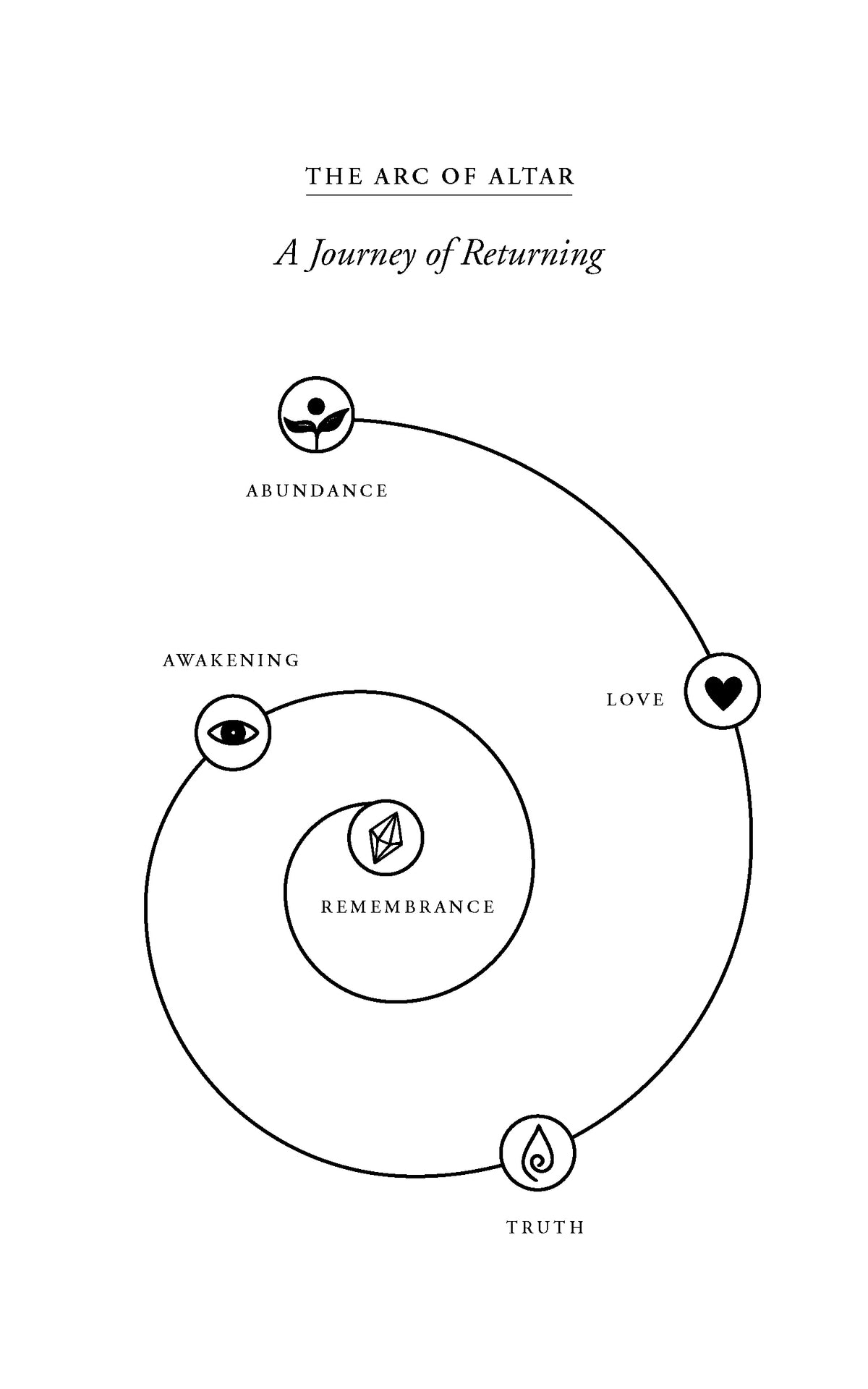
The Arc of Altar: A Journey of Returning
I: Abundance
Beginning with remembering your inherent worth and enoughness. Why here? Because the soul cannot heal, love, or awaken from scarcity or survival mode.
II: Love
Once abundance is remembered, you reclaim the power to love and be loved without disappearing. Why next? Because love is the doorway we must walk through in order to access deeper truth.
III: Truth
From the womb of love, you confront all that is false or hidden, inviting radical authenticity. Why now? Because truth sets the stage for awakening.
IV: Awakening
With truth in place, you shed separation, illusion, and boundary, stepping into inner union and spiritual rebirth.
V: Remembrance
The final homecoming, recognizing you are (and always were) whole, divine, and part of the sacred story of humanity.
Dedication
For the seekers. For the ones who keep asking hard questions even when answers don’t come easy. For those who knock at the door of the divine with trembling hands, and seek truth even when it costs you your comfort. The brave ones who walk away from what no longer fits in order to walk toward a more aligned future that is not yet fully formed. Who trust there is something holy on the other side of unraveling. This is for you.
"Ask, and it will be given to you; seek, and you will find; knock, and the door will be opened to you." —Matthew 7:7
May this book be a door.
May you walk through it
and find more of yourself inside.
Preface: How This Book Found Me
I didn’t set out to write a book. I set out to heal the voice inside my head that said,
"They’ll laugh at you behind your back. No one really cares. Even the ones who say they do are secretly critiquing you. They’re not moved…they’re mocking you."
You see, I could have written ten books by now. I’ve started them again and again. Notebooks, voice notes, half-finished Google Docs, honest lines scribbled in the middle of the night. I’ve written about love, loss, longing, healing, and grief. But that voice always got in the way.
I remember the exact moment it rooted itself in me. Fifth grade. I had just had my first heartbreak and did what any emotionally brave eleven-year-old would do: I wrote him a letter. I poured my raw, honest feelings onto the page, which apparently, was way too much for my age. I thought maybe if I told him how I felt, he’d love me back.
But he didn’t. Instead, his mom found the note. She called my mom and read it aloud, word-for-word. They laughed about how "cute" it was that I thought I knew what love meant. How dramatic I was. How much I felt.
I was humiliated. Ashamed. Exposed.
My mom, concerned and confused, came to me about it. She said I had "such big feelings." Although she was trying to understand me, what I heard was: You’re too much. You need to tone it down. You don’t know what you’re talking about.
That’s when I started hiding. Not just my feelings, but myself.
After that, I stopped speaking my truth out loud. I still wrote, but only in secret. My diary became my sanctuary. It was the only place I could tell the truth without being laughed at, and where I could hurt and rage and love without fear of being misunderstood.
Out in the world, I learned to perform. I smiled when I was hurting. I pretended I was fine when I wasn’t. I laughed things off and got good at acting like I didn’t care—like I didn’t feel everything, all the time.
And the voice that told me no one would understand me? It came back. It camped out. It made a home in my throat and began to block the sacred channel of my self-expression.
You can try, but they’ll never get it.
You’ll never say it the right way.
Don’t embarrass yourself again.
Eventually, that voice became louder than my own. So I muted myself.
Little by little, I stopped expressing. Then I stopped feeling myself. I filtered. Smoothed the edges. Bit my tongue. Shut it all down.
My creativity didn’t disappear, it went underground, buried beneath the fear of being seen too clearly.
But nearly twenty-five years later, here’s what I’ve learned:
When you silence your voice, you don’t just lose your words.
You lose your connection to Source.
To your aliveness.
To your humanity.
You slowly go numb.
You stop creating. Then you stop caring.
Then you stop connecting.